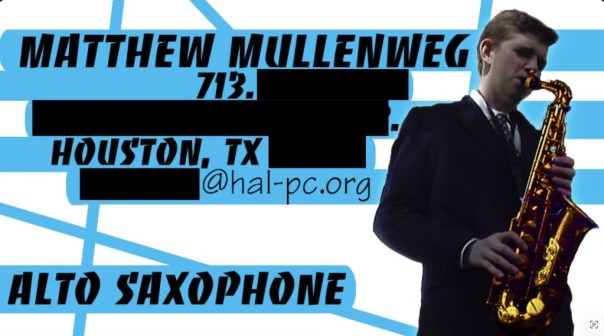
I recently came across a few old business cards I designed back in 1999. The first ones were for my services as a saxophone player:
A few notes:
I went mostly by “Matthew” then.
At some point I decided to remove the home address and say that I was available to play not just alto saxophone but baritone, tenor, and soprano as well.
The number was the home shared house number, not a cell phone.
The email was an email address the entire family shared, under my dad’s name.
HAL-PC was an amazing non-profit local to Houston that stood for the “Houston Area League of PC users.” There was a pretty reasonable annual membership fee, and they hosted a monthly general meeting which had hundreds of attendees, always with a presentation or two and a raffle giveaway at the end. They were a dial-up ISP and BBS/newsgroup host. I volunteered for them by going in on Saturdays where they had a room people could bring their broken computers to and get free tech support, and by hosting a SIG, or special-interest group, around PalmOS called HPUG, the Houston Palm Users Group. This was a big part of the inspiration for WordCamps.
This was for my “design” business:
I would also design business cards for friends, here’s one for my friend who was a percussionist and vibraphonist, Chase Jordan:
A few publishers assembled to come up with a license standard for machines, aka AI. As site builders, or owners, you’ll be interested that there has been some work on the way. More below.
Have a splendid weekend ahead!
Yours, Birgit
Table of Contents
WordCamp US
As mentioned, the recordings of the Workshop are now online. The block and site editor related ones are:
If you are listening via Spotify, please leave a comment. If you listen via other podcast apps, please leave a review. It’ll help with the distribution.
Plugins, Themes, and Tools for #nocode site builders and owners
In her latest post, The Pattern System: Publish Faster with Reusable WordPress Layouts, Anam Hassan breaks down how WordPress Patterns can save you tons of time by letting you reuse the same layouts over and over instead of rebuilding them from scratch. She explains three types: synced patterns that automatically update everywhere when you change them once, unsynced patterns that give you the same starting template but let you customize each one differently, and locked patterns that keep your design safe when other people are writing content.
Tune in to the latest episode of the WP Behind the Builds podcast on Open Channels. The Founders of Podcaster Plus Share Product Development Experiences and Community Insights. Host Mark Westguard speaks with Dan Maby and Nathan Wrigley, founders of Podcaster Plus, about their new WordPress plugin designed to simplify podcast publishing and customize audio players. The plugin uses the Interactivity API for modular blocks like play buttons and volume controls, enabling users to create personalized audio players. Podcaster Plus automates publishing by generating posts for new episodes in RSS feeds and offers add-ons for custom post types, SEO, and automation.
You can sign up for the beta of the new plugin at the website PodcasterPlus.
Theme Development for Full Site Editing and Blocks
On the WordPress Developer Blog, Justin Tadlock published an in-depth tutorial on Building a light/dark toggle with the Interactivity API. He demonstrates creating a toggle that works without custom blocks using modern CSS techniques and WordPress APIs. The tutorial covers theme setup, color scheme storage using user meta and cookies, implementing the toggle button with interactivity directives, adding JavaScript functionality, styling with icons, and registering a block variation for easy editor insertion, resulting in a complete light/dark mode toggle for block themes. You can follow along on the Block Developer Cook Book website.
Jason Crist published a new plugin: Synced Patterns for Themes. He writes in the description, “This plugin enables theme developers to ship patterns that behave as synced patterns (reusable blocks) while maintaining the benefits of theme-bundled patterns. When a theme pattern is marked as synced, it automatically becomes available as a reusable block that updates across all instances when modified.” The plugin description also elaborates on the features and how to use it.
Crist also authored the Pattern Builder plugin, you can also find in the repository. “Pattern Builder transforms how you work with WordPress block patterns, providing a comprehensive solution for creating, managing, and organizing patterns right from your WordPress admin.”
I have not tested these plugins. Use at your own risk!
Bud Kraus again has a great tutorial to unregister all kinds of core block features, i.e., block styles, blocks, or theme style variations. He shows you example code and also what happens when things are unregistered that were already in use. Check out his blog post on Kinsta: Unregistering style variations in a WordPress block theme.
“Keeping up with Gutenberg – Index 2025” A chronological list of the WordPress Make Blog posts from various teams involved in Gutenberg development: Design, Theme Review Team, Core Editor, Core JS, Core CSS, Test, and Meta team from Jan. 2024 on. Updated by yours truly. The previous years are also available: 2020 | 2021 | 2022 | 2023 | 2024
Building Blocks and Tools for the Block editor.
Ryan Welcher chips away at his Block Development Cookbook series on YouTube. In the video How To Convert WordPress Blocks Into (Almost) Anything!, you learn how to enable transforms for your blocks, a way to migrate a current block into a different block. The block editor has a few transforms out of the box, like changing the content of a paragraph block into a list block. Or a into a Quote block without losing the content. Ryan helps you solve this using the transform API for your custom blocks.
New in the Playground world
In his post, The future of WordPress? A complete website from nothing but a link, Jamie Marsland explores how WordPress Playground runs entirely in your browser without servers or setup, and Blueprints transform it from a demo into a powerful tool. Blueprints are recipes that create complete professional websites with one click, benefiting agencies, educators, freelancers, and developers. Marsland built PootlePlayground.com and PootleSites.com to expand Blueprint creation capabilities. The future roadmap aims to push these temporary browser sites into permanent hosting.
AI News
In his post, Boosting WordPress Development with GitHub Copilot, Seth Rubenstein explains how GitHub Copilot, an AI coding assistant, helped his team quickly build four WordPress features that would have taken months to complete manually. The AI handled tasks like creating admin panels and fixing SEO titles with minimal human oversight. However, the AI couldn’t test its own work, so Rubenstein integrated WordPress Playground, a browser-based testing environment, allowing the AI to actually browse and check the websites it builds, making the development process more reliable and efficient. Rubenstein shared all the details of how he accomplished it.
Matt Mullenwegshared on his blog, “one of the more interesting things to launch.” this week:
RSL (Really Simple Licensing) is an open standard that helps content publishers protect their rights in the AI era by embedding machine-readable licensing terms directly into web pages using XML markup.
The system supports various compensation models, including attribution-based licensing, pay-per-crawl, and pay-per-inference arrangements. Publishers can specify different terms for different usage types, particularly for AI training applications.
The standard addresses challenges content creators face with AI systems using their work without clear compensation or attribution by providing a structured format that automated tools can understand and respect, giving creators standardized control over their content usage.
The founders are Eckart Walther, who is also the co-creator of the RSS (Really Simple Syndication) standard, and Doug Leeds, former CEO of Ask.com and former CEO of IAC Publishing.
The RSL team has established a collective licensing organization, the RSL Collective, that can negotiate terms and collect royalties, similar to ASCAP for musicians or MPLC for films.
James Le Page, team rep on the WordPress AI team, built a first version of a plugin for publishers using WordPress: RSL Licensing for WordPress.
And I am left to wonder how public LLMs adhere to this standard and more interestingly, if they will pay licensing fees. Brandom wrote, “Without some kind of licensing system, AI companies could face an avalanche of copyright lawsuits that some worry will set the industry back permanently.”
Now also available via WordPress Playground. There is no need for a test site locally or on a server. Have you been using it? Email me with your experience
Questions? Suggestions? Ideas? Don’t hesitate to send them via email or send me a message on WordPress Slack or Twitter @bph.
Just got word that the court dismissed several of WP Engine and Silver Lake’s most serious claims — antitrust, monopolization, and extortion have been knocked out! These were by far the most significant and far-reaching allegations in the case and with today’s decision the case is narrowed significantly. This is a win not just for us but for all open source maintainers and contributors. Huge thanks to the folks at Gibson and Automattic who have been working on this.
With respect to any remaining claims, we’re confident the facts will demonstrate that our actions were lawful and in the best interests of the WordPress community.
This ruling is a significant milestone, but our focus remains the same: building a free, open, and thriving WordPress ecosystem and supporting the millions of people who rely on it every day.
From cleaning hacked WordPress sites to running a 7-person security plugin company, Robert Abela never planned to become an entrepreneur. But when he discovered a critical gap in WordPress security logging, everything changed.
That led him to build WP Activity Log, which grew from a hobby project into Melapress. The company has developed some of WordPress’s most trusted security plugins, including WP Activity Log, WP2FA, and Melapress Login Security.
In this interview, Robert shares how he built his plugin business through organic marketing and community relationships. He also reveals the lessons he learned scaling from solo developer to leading a growing team.
“The difference between the best plugins out there in each category… is always maybe that 10%… we always go that extra step.”
Robert Abela – CEO & Founder of Melapress
Keep reading to learn how Robert Abela built one of the most successful WordPress security plugins on the market.
📣 This is our series, #MyWordPressStory, which brings you insights from some of the most successful leaders in the WordPress industry.
If you’d like to be featured in our interview series – whether you’re a plugin developer, founder, or SEO expert – feel free to reach out and let us know through our contact form.
Video Interview with Robert Abela
If you’d like to check out our complete video interview with Robert Abela, then you can watch it below:
Or you can use the links below to see what we covered in the interview (and more):
🙋♂️ Meet Robert Abela: Systems Engineer Turned Security Expert
Robert Abela didn’t start as a plugin developer or WordPress entrepreneur.
For over a decade, he worked as a systems engineer at software companies, with his final role at Acunetix, a company that developed web security scanning tools.
“Around 13 years ago I quit my corporate job. I always worked for software companies, startups, most of them.”
Robert Abela
But he didn’t leave because he didn’t like the job. It was simply time for a change. His background in software security and systems engineering would prove invaluable for what came next.
When Acunetix needed a blog around 2009, they turned to WordPress. This was Robert’s introduction to the platform that would eventually change his career trajectory.
WordPress security was very different back then, and Robert’s background gave him a unique perspective on the platform’s vulnerabilities.
As a systems engineer, Robert gained exposure to every department within software companies — from marketing and sales to development and R&D.
This cross-functional experience gave him insights into how software businesses actually operate. This knowledge would become crucial when building his own company.
“You get a good understanding of the inner workings of a software company, what should be done and not.”
Robert Abela
After leaving his corporate role, Robert began freelance work cleaning hacked WordPress websites, combining his security expertise with his growing WordPress knowledge.
He didn’t realize it at the time, but this work would help him expose a gap in WordPress security. That gap would later define his entrepreneurial path and lead him to create Melapress.
🔧 Building WP Activity Log: The Problem That Started Everything
Website cleanup work in the early days of WordPress was challenging. Robert found himself constantly dealing with hacked sites, trying to understand what went wrong and how to prevent it from happening again.
“There was no sort of logging… you need to see what happened before it got hacked. Was the plugin maybe updated? Maybe a user installed something? Maybe a user was created? And yeah, there was nothing like that.”
Robert Abela
This wasn’t just a minor inconvenience. It was a fundamental gap that made security work unnecessarily difficult and time-consuming.
The business side of website cleanup also presented its own challenges.
“It wasn’t very scalable and it was a very difficult job… there were prices like people were cleaning websites for $99, and sometimes it could be a job which takes a couple of days,” Robert explained.
In these early days, Robert was competing with many other cleanup services in a race to the bottom on pricing. It was clear this wasn’t a sustainable long-term business model.
But Robert saw an opportunity to solve the underlying problem rather than just treating the symptoms.
The logging capability that WordPress was missing could help both professionals and site owners understand and prevent security issues.
There was one small problem, though: Robert wasn’t really a developer.
“I’m not a developer per se. I can read and write code but something that I can do in a week and a proper developer can do it properly in one day… It took me a few months playing around and breaking things basically…”
Robert Abela
Despite the learning curve, Robert kept trying. He developed the first version of WP Activity Log as both a solution to his professional needs and a way to learn coding skills.
“It started as a hobby,” Robert said. The first year brought in around $1,000 in revenue, hardly life-changing money, but enough to suggest there was real interest in the solution.
“But yeah, then it’s like, maybe this can happen actually, you know?”
That moment of realization marked the beginning of what would become a six-year transition from hobby project to full-time business.
💥 Related Post: Tobias Bäthge turned a hobby project for his baseball team into TablePress, a WordPress plugin that now powers more than 700K sites. Read the full interview to see how he did it.
🌱 Growing Through Community, Not Marketing Dollars
For the first six years of WP Activity Log’s existence, Robert spent exactly zero dollars on marketing. Instead, he built his user base through authentic community engagement and content creation.
“I never spent a penny on marketing before six years ago. It was all organic and just connections talking to people.”
Robert Abela
His marketing strategy was refreshingly simple: write helpful blog posts, build a newsletter for people interested in WordPress security content, and attend WordPress community events.
When the newsletter went out with security tips and insights, it might include a mention of the plugin at the bottom. But the focus was always on providing value first.
The real turning point came in 2013 when Robert attended the first WordCamp Europe in Leiden. This decision would shape how he thought about building relationships in the WordPress space.
“If I send an email to someone right now who I’ve never met in person… they will ignore you but if you know them you’ve met them in person… it’s different.”
Robert Abela
WordCamps and local WordPress meetups became Robert’s main networking strategy.
The relationships he built at these events led to collaborations, cross-promotion opportunities, and genuine friendships within the WordPress community.
Beyond the business benefits, these events provided something equally important during the challenging transition years: community and support.
“At meetups and at WordCamps, I met people in the same position as I was. So you could share ideas. We could help each other… It feels a bit less lonely.”
Robert Abela
Building a side business while maintaining full-time work can be isolating.
But seeing other entrepreneurs deal with similar challenges provided both practical insights and emotional support during the long period before WP Activity Log could support Robert full-time.
The organic approach worked, but it required patience. It took several years of consistent content creation, community engagement, and gradual word-of-mouth growth before the plugin gained significant traction.
But this slow build created a solid foundation of users who genuinely valued the product and became advocates for it.
💡 What Makes Plugins Stand Out: Feedback & Going the Extra Mile
After years of studying successful WordPress plugins, Robert developed a clear philosophy about what separates the winners from the competition in each category.
“The difference between the best plugins out there in each category and those which follow… is always maybe that 10%… Instead of stopping at 90%, they went up to 95, 96%,” he explained.
It’s not about revolutionary features or completely different approaches.
The top plugins in any category are often similar to their competitors, but they go that extra step in execution, user experience, and support quality.
This philosophy extends far beyond just the software itself. Robert believes exceptional support is often what transforms a good plugin into a market leader.
“Support is really important because you can have the best software in the world. If you don’t have support, slowly, slowly, you start losing customers.”
Robert Abela
Even today, with a team of seven people, Robert still handles support tickets himself.
It’s not because he has to. It’s because staying connected to users provides invaluable insights into how the plugins are actually being used.
“Every morning I like to try just support tickets myself… because I feel that if I don’t do that, I would be segregating myself in my own world,” he said.
This direct connection to users has revealed use cases that Robert never anticipated when first building WP Activity Log.
While he designed it mostly as a security tool for tracking potential breaches, users found creative applications he hadn’t considered.
“You designed your plugin to be used for A, B, and C, but people are using it for A, B, C, D, E, F, G, H… So you get these ideas.”
Robert Abela
For instance, Robert has learned that magazine websites use his plugin to monitor editor productivity and track how many articles writers complete each week.
Online learning platforms have even used it to see which students are completing courses and which are dropping off.
These insights help with feature development and product positioning. Robert uses a simple rule for prioritizing new features based on user feedback.
“If we think 80% of people are going to use it, then we’re going to give it priority. If it’s something that we think only 20% or less… then maybe it gets much lower priority.”
Robert Abela
The combination of exceptional support and user-driven development created strong customer loyalty that would prove very important as Robert prepared to make a major leap.
He decided to transform his side project into Melapress, which is now a full-time business with multiple plugins and a growing team.
🚀 Scaling Melapress: Multiple Plugins and a Growing Team
Once WP Activity Log gained traction, Robert began thinking beyond a single plugin.
Relying on one product for all revenue felt risky — and his security background gave him plenty of ideas for other pain points he could solve.
“I never liked the idea of relying on one plugin as an income source,” he explained. “At least if something happens… it’s good to have a few different products, a few different income streams.”
Robert Abela
The next opportunity came from an internal need.
Robert had started working with guest authors and needed them to use two-factor authentication. But the existing 2FA plugins were built by developers, for developers — not everyday WordPress users.
So, he built his own.
The first version of WP 2FA did the same core job as other 2FA plugins. But it also added a simple setup wizard and smart enforcement policies that made onboarding much easier for non-technical users.
Today, WP2FA is one of the most popular 2FA plugins in the WordPress plugin repository.
But the approach remains the same: identify a real need, build something better, and test it out.
To support this growth, Robert also began hiring, and he was intentional about the kind of people he brought in.
Whether it’s marketing, testing, design, or development, Robert doesn’t just want execution. He wants collaboration.
“I want people who actually… with whom I can have very very good discussions… People who come in and say, ‘This could be better,’ and bring in ideas I haven’t thought of.”
Robert Abela
That philosophy has helped turn Melapress into a thriving 7-person company — one that’s continuing to grow by listening to users and focusing on quality above all else.
💥 Interested in more lessons from successful WordPress entrepreneurs? Check out our full interview with Nicolas Lecocq, the creator of the OceanWP theme and the founder of DigiHold.
🎯 Lessons Learned: What Robert Would Do Differently Today
Robert’s journey from freelancer to founder didn’t follow a straight line, and that’s exactly what makes it so relatable.
For the first several years, Melapress (originally WP White Security) evolved through experimentation, not long-term strategy.
Plugin ideas were pursued on instinct. Systems were built (and sometimes rebuilt) as the business grew.
That approach worked. But if Robert were starting over today, he says he’d be more intentional.
“I would… plan a bit more, do a bit more… be a bit less impulsive and make more informed decisions.”
Robert Abela
Without clear planning, early decisions sometimes led to technical or business debt that had to be reversed later.
“You end up two, three years later like… now we have to reverse this.”
Still, Robert doesn’t regret the organic path that got him here. In fact, he sees it as a necessary part of learning.
“I never planned it. Everything happened like… let’s try this, it’s working… It wasn’t planned that it would grow to a full-time job, but it did.”
Robert Abela
His experience is a reminder that while planning is important, progress often comes from action. This is especially true when it’s paired with curiosity, user feedback, and consistent effort over time.
💭 Final Thoughts & Where to Find Robert’s Work
Today, Robert runs a growing plugin business, but he hasn’t lost touch with the users who made it possible.
He still checks support messages personally. He still replies to plugin emails. And he still believes that direct contact with customers is what sets great companies apart from the rest.
“Some people sometimes are surprised… they say, ‘I never thought you’d reply.’ Yeah, we do check the emails.”
Robert Abela
That customer-first philosophy has helped Melapress grow from a solo side project into a trusted brand in WordPress security. It’s used by thousands of site owners and supported by a passionate team.
If you’d like to learn more about Robert’s work, you can check out the Melapress website. Or feel free to reach out via their contact page.
🌟 Want to learn more about the state of WordPress security today? Check out the results of the Melapress annual security survey — it’s full of interesting and up-to-date statistics.
📚 Bonus: Expert Resources for WordPress Security and Plugin Development
Want to follow in Robert’s footsteps and build your own successful plugin business?
Whether you’re just starting out or scaling your next product, here are some hand-picked WPBeginner resources to help you grow:
It’s been a busy (and tragic) week but one of the more interesting things to launch was the Really Simple Licensing standard. I have a lot of scars from the web standards wars, so I’m hesitant to dive back in, but this is from a lot of the early Web 2.0 people, as TechCrunch writes about.
When I studied economics, one of the concepts that struck me the most was the concept of externalities. This International Monetary Fund post explains it well. In short, externalities are costs or benefits of an economic activity that affect third parties who did not choose to incur them, leading to a divergence between private and social costs or benefits. They’re spillover effects—positive or negative—that the market price fails to reflect. A classic example is air pollution from a factory, where nearby residents bear health and environmental costs not included in the price of the factory’s products.
Open source is full of externalities. On the positive side, adoption creates ecosystems of developers and provides many paths of distribution. On the negative side, there’s often underinvestment in the very projects that sustain the ecosystem. I have a lot of empathy for why, when open source meets finance and private equity, things can go sideways. You can look at a business built on open source and see seemingly amazing margins—efficient R&D that compounds in a DCF model. A percent here or there over many years really adds up.
My plea to investors in open-source businesses is this: when a business is built on top of open source, incorporate a restorative investment percentage back into the projects critical to the end-user experience of what you’re offering customers. In WordPress, we call this Five for the Future, but it doesn’t have to be five percent; it could be 0.1%. Plan for it when modeling your expected IRR hurdle from an investment. Then, a few years down the line, when the small percentages start to add up, you won’t face a big catch-up or gap.
This underinvestment is itself an externality. It doesn’t appear on the balance sheet, but it can manifest in black swan events, such as security breaches or remote code exploits. Technical debt is one of the largest unaccounted-for externalities in the world today. Engineering, in the long run, is primarily a craft of maintenance rather than creation. The bulk of the cost of something comes from its upkeep over time.
In this WP Behind the Builds episode, Mark Westguard discusses the upcoming Podcaster Plus plugin with founders Nathan and Dan, emphasizing its features like customizable audio players and automation for podcasters.


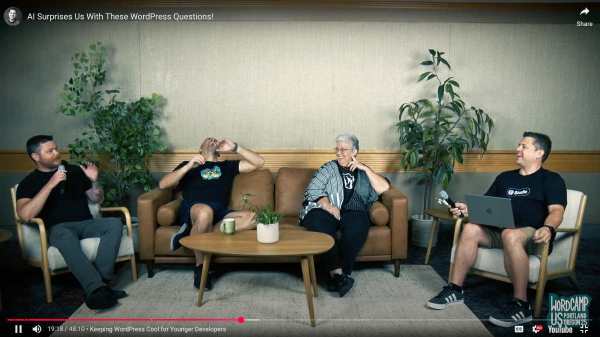


 The latest episode is


 Robert Abela – CEO & Founder of Melapress